
The AHT20 is a compact digital environmental sensor that measures both temperature and relative humidity. Combining the two measurements in a single device makes it useful for projects such as indoor environmental monitors, weather instruments, greenhouse controllers, ventilation systems and simple data loggers.
Unlike an analogue temperature or humidity sensor, the AHT20 performs the sensing and analogue-to-digital conversion internally. The ATmega4809 therefore receives digital measurement data rather than having to measure a small analogue voltage with its own ADC.
Communication with the AHT20 takes place over I2C, making the sensor a useful practical peripheral for exploring the ATmega4809’s TWI hardware. The device normally uses the fixed 7-bit I2C address 0x38. Rather than continuously presenting temperature and humidity values that can simply be read at any time, the sensor uses a measurement sequence.
The microcontroller checks or initialises the device as required, sends a command to trigger a measurement, waits for the conversion to complete and then retrieves the resulting data. The returned bytes contain status information together with the raw humidity and temperature measurements, which must be extracted and converted into useful engineering units by the firmware.
Both measurements are represented internally using 20-bit values. Relative humidity can be calculated from the raw humidity value as RH = raw × 100 / 2^20, producing a percentage value. Temperature uses a similar conversion, with T = raw × 200 / 2^20 - 50 to obtain degrees Celsius.
Understanding these conversions is useful when writing the driver directly in C because it makes clear that the values returned over I2C are encoded measurement counts rather than ready-to-display Celsius and percentage values. It also provides an opportunity to decide whether floating-point calculations are appropriate or whether scaled integer arithmetic would be preferable on the ATmega4809.
The AHT20 operates from approximately 2.0 V to 5.5 V and is specified for humidity measurements across 0–100% RH and temperature measurements from -40°C to +85°C. Typical accuracy is approximately ±2% RH for relative humidity and ±0.3°C for temperature under normal operating conditions.
The device has low power requirements, with current consumption dropping substantially when it is not actively taking a measurement. These characteristics make it suitable for both continuously powered experiments and applications where environmental readings are collected periodically to reduce energy consumption.
Setup
I use an AHT20 sensor connected using the QWIK connector on the Curiosity Nano Explorer
- PA2 – SDA I2C Data, connected to both AHT20 & SSD1306)
- PA3 – SCL I2C Clock, connected to both AHT20 & SSD1306)
- PF5 – Onboard Heartbeat LED (Toggles on successful read)
Code
#define F_CPU 3333333UL // Default ATmega4809 internal oscillator clock (20MHz / 6)
#include <avr/io.h>
#include <util/delay.h>

// I2C 7-Bit Addresses
#define AHT20_I2C_ADDR   0x38
#define SSD1306_I2C_ADDR 0x3D

// Onboard LED Definition (PF5 on Curiosity Nano)
#define HEARTBEAT_LED_MASK PIN5_bm

// --- Font Table (ASCII 32 to 90: ' ' through 'Z') ---
const uint8_t FONT_5x7[][5] = {
    {0x00, 0x00, 0x00, 0x00, 0x00}, // ' '
    {0x00, 0x00, 0x5F, 0x00, 0x00}, // '!'
    {0x00, 0x07, 0x00, 0x07, 0x00}, // '"'
    {0x14, 0x7F, 0x14, 0x7F, 0x14}, // '#'
    {0x24, 0x2A, 0x7F, 0x2A, 0x12}, // '$'
    {0x23, 0x13, 0x08, 0x64, 0x62}, // '%'
    {0x36, 0x49, 0x55, 0x22, 0x50}, // '&'
    {0x00, 0x05, 0x03, 0x00, 0x00}, // '\''
    {0x00, 0x1C, 0x22, 0x41, 0x00}, // '('
    {0x00, 0x41, 0x22, 0x1C, 0x00}, // ')'
    {0x14, 0x08, 0x3E, 0x08, 0x14}, // '*'
    {0x08, 0x08, 0x3E, 0x08, 0x08}, // '+'
    {0x00, 0x50, 0x30, 0x00, 0x00}, // ','
    {0x08, 0x08, 0x08, 0x08, 0x08}, // '-'
    {0x00, 0x60, 0x60, 0x00, 0x00}, // '.'
    {0x20, 0x10, 0x08, 0x04, 0x02}, // '/'
    {0x3E, 0x51, 0x49, 0x45, 0x3E}, // '0'
    {0x00, 0x42, 0x7F, 0x40, 0x00}, // '1'
    {0x42, 0x61, 0x51, 0x49, 0x46}, // '2'
    {0x21, 0x41, 0x45, 0x4B, 0x31}, // '3'
    {0x18, 0x14, 0x12, 0x7F, 0x10}, // '4'
    {0x27, 0x45, 0x45, 0x45, 0x39}, // '5'
    {0x3C, 0x4A, 0x49, 0x49, 0x30}, // '6'
    {0x01, 0x71, 0x09, 0x05, 0x03}, // '7'
    {0x36, 0x49, 0x49, 0x49, 0x36}, // '8'
    {0x06, 0x49, 0x49, 0x29, 0x1E}, // '9'
    {0x00, 0x36, 0x36, 0x00, 0x00}, // ':'
    {0x00, 0x56, 0x36, 0x00, 0x00}, // ';'
    {0x08, 0x14, 0x22, 0x41, 0x00}, // '<'
    {0x14, 0x14, 0x14, 0x14, 0x14}, // '='
    {0x00, 0x41, 0x22, 0x14, 0x08}, // '>'
    {0x02, 0x01, 0x51, 0x09, 0x06}, // '?'
    {0x32, 0x49, 0x79, 0x41, 0x3E}, // '@'
    {0x7E, 0x11, 0x11, 0x11, 0x7E}, // 'A'
    {0x7F, 0x49, 0x49, 0x49, 0x36}, // 'B'
    {0x3E, 0x41, 0x41, 0x41, 0x22}, // 'C'
    {0x7F, 0x41, 0x41, 0x22, 0x1C}, // 'D'
    {0x7F, 0x49, 0x49, 0x49, 0x41}, // 'E'
    {0x7F, 0x09, 0x09, 0x09, 0x01}, // 'F'
    {0x3E, 0x41, 0x49, 0x49, 0x7A}, // 'G'
    {0x7F, 0x08, 0x08, 0x08, 0x7F}, // 'H'
    {0x00, 0x41, 0x7F, 0x41, 0x00}, // 'I'
    {0x20, 0x40, 0x41, 0x3F, 0x01}, // 'J'
    {0x7F, 0x08, 0x14, 0x22, 0x41}, // 'K'
    {0x7F, 0x40, 0x40, 0x40, 0x40}, // 'L'
    {0x7F, 0x02, 0x0C, 0x02, 0x7F}, // 'M'
    {0x7F, 0x04, 0x08, 0x10, 0x7F}, // 'N'
    {0x3E, 0x41, 0x41, 0x41, 0x3E}, // 'O'
    {0x7F, 0x09, 0x09, 0x09, 0x06}, // 'P'
    {0x3E, 0x41, 0x51, 0x21, 0x5E}, // 'Q'
    {0x7F, 0x09, 0x19, 0x29, 0x46}, // 'R'
    {0x46, 0x49, 0x49, 0x49, 0x31}, // 'S'
    {0x01, 0x01, 0x7F, 0x01, 0x01}, // 'T'
    {0x3F, 0x40, 0x40, 0x40, 0x3F}, // 'U'
    {0x1F, 0x20, 0x40, 0x20, 0x1F}, // 'V'
    {0x3F, 0x40, 0x38, 0x40, 0x3F}, // 'W'
    {0x63, 0x14, 0x08, 0x14, 0x63}, // 'X'
    {0x07, 0x08, 0x70, 0x08, 0x07}, // 'Y'
    {0x61, 0x51, 0x49, 0x45, 0x43}  // 'Z'
};

// --- Hardware (I2C) Driver ---
void TWI0_Init(void) {
    PORTA.DIRCLR = PIN2_bm | PIN3_bm;
    PORTA.PIN2CTRL = PORT_PULLUPEN_bm; // Enable pull-up PA2 (SDA)
    PORTA.PIN3CTRL = PORT_PULLUPEN_bm; // Enable pull-up PA3 (SCL)

    TWI0.MBAUD = 12; // ~100 kHz @ 3.33MHz internal clock
    TWI0.MCTRLA = TWI_ENABLE_bm;
    TWI0.MSTATUS = TWI_BUSSTATE_IDLE_gc; // Initialize to IDLE state
}

uint8_t TWI0_Start(uint8_t addr_rw) {
    TWI0.MADDR = addr_rw;
    while (!(TWI0.MSTATUS & (TWI_RIF_bm | TWI_WIF_bm)));

    if (TWI0.MSTATUS & TWI_RXACK_bm) { // NACK received
        TWI0.MCTRLB = TWI_MCMD_STOP_gc;
        return 0;
    }
    return 1;
}

uint8_t TWI0_Write(uint8_t data) {
    TWI0.MDATA = data;
    while (!(TWI0.MSTATUS & TWI_WIF_bm));

    if (TWI0.MSTATUS & TWI_RXACK_bm) {
        return 0; // NACK
    }
    return 1; // ACK
}

uint8_t TWI0_Read(uint8_t ack) {
    while (!(TWI0.MSTATUS & TWI_RIF_bm));
    uint8_t data = TWI0.MDATA;

    if (ack) {
        TWI0.MCTRLB = TWI_MCMD_RECVTRANS_gc;
    } else {
        TWI0.MCTRLB = TWI_ACKACT_NACK_gc | TWI_MCMD_STOP_gc;
    }
    return data;
}

void TWI0_Stop(void) {
    TWI0.MCTRLB = TWI_MCMD_STOP_gc;
}

// --- AHT20 Sensor  ---
void AHT20_Init(void) {
    _delay_ms(40);
    if (TWI0_Start((AHT20_I2C_ADDR << 1) | 0)) {
        TWI0_Write(0x71);
        if (TWI0_Start((AHT20_I2C_ADDR << 1) | 1)) {
            uint8_t status = TWI0_Read(0);
            if (!(status & (1 << 3))) { // If not calibrated, send calibration
                TWI0_Start((AHT20_I2C_ADDR << 1) | 0);
                TWI0_Write(0xBE);
                TWI0_Write(0x08);
                TWI0_Write(0x00);
                TWI0_Stop();
                _delay_ms(10);
            }
        }
    }
}

uint8_t AHT20_Read(float *temp, float *humidity) {
    if (!TWI0_Start((AHT20_I2C_ADDR << 1) | 0)) return 0;
    TWI0_Write(0xAC);
    TWI0_Write(0x33);
    TWI0_Write(0x00);
    TWI0_Stop();

    _delay_ms(80); // Measurement delay

    if (!TWI0_Start((AHT20_I2C_ADDR << 1) | 1)) return 0;

    uint8_t data[7];
    for (uint8_t i = 0; i < 6; i++) {
        data[i] = TWI0_Read(1);
    }
    data[6] = TWI0_Read(0);

    if (data[0] & 0x80) return 0; // Sensor busy bit active

    uint32_t raw_hum = (((uint32_t)data[1] << 16) | ((uint32_t)data[2] << 8) | (uint32_t)data[3]) >> 4;
    *humidity = ((float)raw_hum / 1048576.0f) * 100.0f;

    uint32_t raw_temp = (((uint32_t)(data[3] & 0x0F) << 16) | ((uint32_t)data[4] << 8) | (uint32_t)data[5]);
    *temp = (((float)raw_temp / 1048576.0f) * 200.0f) - 50.0f;

    return 1;
}

// --- SSD1306 Display  ---
void SSD1306_Command(uint8_t cmd) {
    TWI0_Start((SSD1306_I2C_ADDR << 1) | 0);
    TWI0_Write(0x00);
    TWI0_Write(cmd);
    TWI0_Stop();
}

void SSD1306_Data(uint8_t data) {
    TWI0_Start((SSD1306_I2C_ADDR << 1) | 0);
    TWI0_Write(0x40);
    TWI0_Write(data);
    TWI0_Stop();
}

void SSD1306_Init(void) {
    _delay_ms(100);
    SSD1306_Command(0xAE);
    SSD1306_Command(0xD5); SSD1306_Command(0x80);
    SSD1306_Command(0xA8); SSD1306_Command(0x3F);
    SSD1306_Command(0xD3); SSD1306_Command(0x00);
    SSD1306_Command(0x40);
    SSD1306_Command(0x8D); SSD1306_Command(0x14);
    SSD1306_Command(0x20); SSD1306_Command(0x00);
    SSD1306_Command(0xA1);
    SSD1306_Command(0xC8);
    SSD1306_Command(0xDA); SSD1306_Command(0x12);
    SSD1306_Command(0x81); SSD1306_Command(0xCF);
    SSD1306_Command(0xD9); SSD1306_Command(0xF1);
    SSD1306_Command(0xDB); SSD1306_Command(0x40);
    SSD1306_Command(0xA4);
    SSD1306_Command(0xA6);
    SSD1306_Command(0xAF);
}

void SSD1306_Clear(void) {
    for (uint8_t page = 0; page < 8; page++) {
        SSD1306_Command(0xB0 + page);
        SSD1306_Command(0x00);
        SSD1306_Command(0x10);
        for (uint8_t col = 0; col < 128; col++) {
            SSD1306_Data(0x00);
        }
    }
}

void SSD1306_DrawChar(char c, uint8_t page, uint8_t col) {
    if (c >= 'a' && c <= 'z') c -= 32;
    if (c < 32 || c > 90) c = ' ';

    uint8_t font_index = c - 32;

    SSD1306_Command(0xB0 + page);
    SSD1306_Command(0x00 + (col & 0x0F));
    SSD1306_Command(0x10 + ((col >> 4) & 0x0F));

    for (uint8_t i = 0; i < 5; i++) {
        SSD1306_Data(FONT_5x7[font_index][i]);
    }
    SSD1306_Data(0x00);
}

void SSD1306_DrawString(const char *str, uint8_t page, uint8_t col) {
    while (*str && col < 122) {
        SSD1306_DrawChar(*str++, page, col);
        col += 6;
    }
}

// Convert float value to formatted string
void Format_Value_String(float val, char *buffer, const char *unit) {
    int whole = (int)val;
    int decimal = (int)((val - (float)whole) * 100.0f);
    if (decimal < 0) decimal = -decimal;

    buffer[0] = (whole / 10) + '0';
    buffer[1] = (whole % 10) + '0';
    buffer[2] = '.';
    buffer[3] = (decimal / 10) + '0';
    buffer[4] = (decimal % 10) + '0';
    buffer[5] = ' ';
    buffer[6] = unit[0];
    buffer[7] = unit[1];
    buffer[8] = '\0';
}

int main(void) {
    // Heartbeat LED setup (PF5)
    PORTF.DIRSET = HEARTBEAT_LED_MASK;
    PORTF.OUTSET = HEARTBEAT_LED_MASK; // LED OFF initially (Active Low)

    TWI0_Init();
    SSD1306_Init();
    SSD1306_Clear();
    AHT20_Init();

    SSD1306_DrawString("ATMEGA4809 NANO", 0, 16);
    SSD1306_DrawString("AHT20 SENSOR", 2, 24);

    float temperature = 0.0f;
    float humidity = 0.0f;
    char valBuffer[10];

    while (1) {
        if (AHT20_Read(&temperature, &humidity)) {
            // Render Temperature
            Format_Value_String(temperature, valBuffer, "C ");
            SSD1306_DrawString("TEMP: ", 5, 10);
            SSD1306_DrawString(valBuffer, 5, 52);

            // Render Humidity
            Format_Value_String(humidity, valBuffer, "% ");
            SSD1306_DrawString("HUM:  ", 7, 10);
            SSD1306_DrawString(valBuffer, 7, 52);

            PORTF.OUTTGL = HEARTBEAT_LED_MASK; // Toggle onboard LED
        }

        _delay_ms(1000);
    }

    return 0;
}
Image
Touch the sensor with your finger and the TEMP value should vary on the OLED
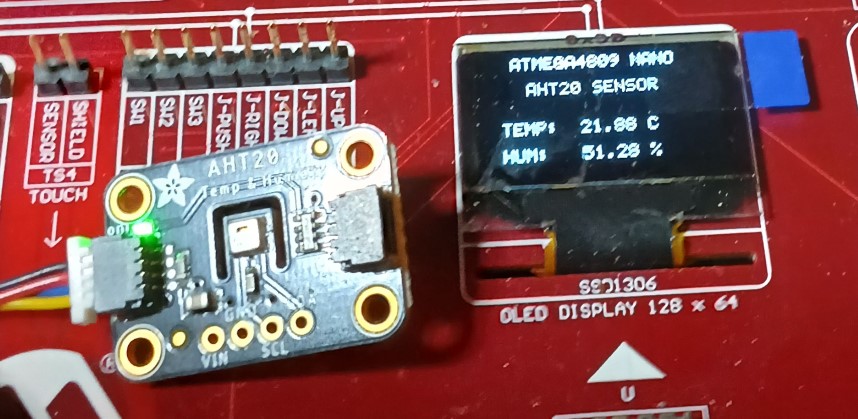
aht20 and OLED